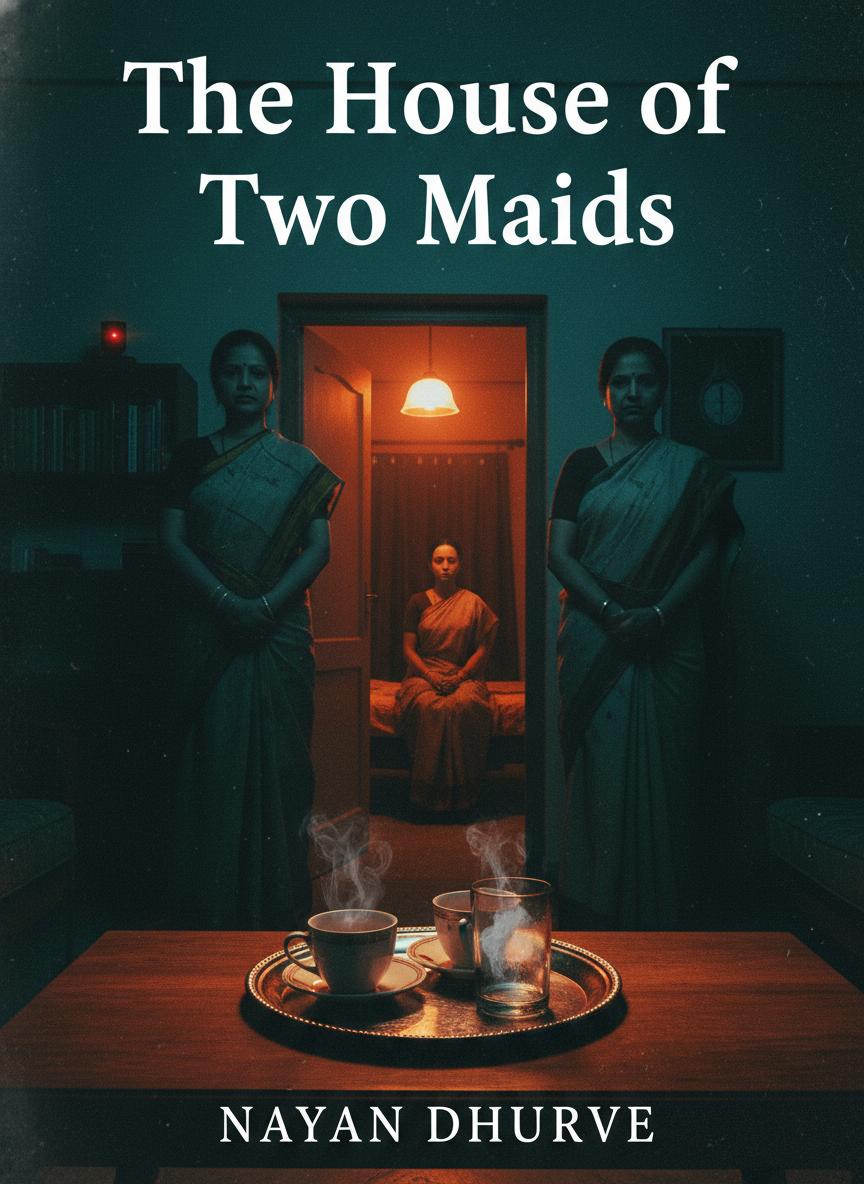
Arun's childhood home is ordinary. A middle-class house on a tree-lined street, where the evening air carries the smell of cumin and the sound of the morning news. His father works long hours. His mother, Priya, keeps the house. His younger sister, Meera, still believes in the future. And two women, Shanta and her niece Kamla, the family's longtime domestic servants, have lived in and around this house for years, cooking, cleaning, pouring the evening tea, first one up and last one down, trusted, invisible, harmless.
Everyone assumes they are ordinary. No one suspects them. No one ever would.
It begins with the tea. Sedatives dissolved into their night cup, slow and subtle, enough to leave Priya and Meera groggy and compliant. While mother and daughter lie heavy in their beds, Shanta and Kamla bring men in. Neighbors. Colleagues. Friends of the family. The rapes happen in the dark, in silence, in the rooms where these women sleep. Hidden cameras do the rest.
Arun discovers everything on his own.
The operation evolves. The drugged sessions are replaced by something more controlled. Clients are warned that resistance will cost them everything. Priya and Meera are trained to comply, to perform, to endure. Blackmail ensures silence. Filming ensures compliance. The father walks through the house every evening, unaware that the meals he eats and the rooms he passes through have become stages for an invisible business.
Arun sees it all.
He wakes in the middle of the night, thirsty, walking past the living room and catching a glimpse through the slightly ajar door. A man inside. Priya and Meera on the floor, barely conscious. Shanta directing things with a calm, practiced authority. He steps back without a sound, drinks his water, returns to bed. Nobody knows he saw anything. Nobody knows he knows.
Over the following weeks, Arun tests his silence. He watches from doorways. He listens through thin walls. He follows Shanta and Kamla's movements, learning their schedules, their language, the coded messages they leave in shared rooms. He becomes a ghost in his own house, present in body, invisible in knowledge. They do not suspect him. He does not give them reason to.
Shanta takes over training. She has studied every manual and every forum, every technique of coercion and compliance. She sits with Priya and Meera during daylight hours, coaching them like actors in a play. Priya's new posture is deliberate. Meera's compliance is rehearsed. Both are told that resistance will be met with footage sent to Rajan immediately. Both are told that their new appearance, their new behavior, their new silence must be explained to the outside world if anyone asks.
The women are broken in slowly. Sleep deprivation first. Isolation second. Then exposure, humiliation, and the slow demolition of the identities Priya and Meera once held. Shanta and Kamla have mapped out a curriculum: posture, obedience, voice control, position discipline. Priya's body is reshaped through diet and restraint. Meera, younger and more fragile, is conditioned with greater intensity, broken more frequently, rebuilt more quickly. Each woman learns to hold still for ten minutes without flinching. Then twenty. Then an hour. Each act is filmed. Each failure is filed. Each humiliation is archived for future leverage.
Public exposure becomes part of the program. Priya serves tea to Rajan's visiting colleagues wearing nothing beneath her sari. Meera kneels in the hallway while Kamla walks past her with clients. Resistance is anticipated and catalogued. Meera attempts to run once. Shanta and Kamla retrieve her, beat her, and reintroduce her to the protocol at higher intensity. Priya tries to hide a letter. The letter is found, read aloud to her, and she is made to read it back. Shame is weaponized with precision. The women learn that silence is the only currency that still has value.
But the most sophisticated layer of the operation is not the violence. It is the fiction. Shanta and Kamla build a narrative for the household. Priya and Meera, when asked, explain their new appearances as self-discovery. They talk about wellness programs and personal transformation. They speak in soft voices, with careful smiles, performing confidence they do not feel. Arun sees through every word. He understands the performance. He also understands that performing complicity with the lie is easier than confronting the truth. So he nods. He accepts the explanations. He begins to wonder whether he is the one losing touch with reality, whether his knowledge has become a private delusion.
The house runs on two frequencies. Rajan wakes, drinks his tea, goes to work, returns, sleeps. Priya and Meera perform for him, for the visitors, and for the men who come after dark. Shanta and Kamla manage every detail. The father is still unaware, but Shanta begins small doses of the same sedative into his evening chai, administered under Kamla's direction. The effect is cumulative. Rajan forgets conversations. He repeats himself. He notices Priya working late, Priya tells him he is tired. He notices Meera has lost weight, Priya says it is a fitness program. He believes them. Slowly, without realizing it, Rajan stops being a father and becomes a resident of the house run by two women.
Priya and Meera, once matriarch and daughter, are repositioned as servants within their own family. They cook. They clean. They wait on clients. They serve the men who know their husband and their brother, and those men never know whose house they are in. Priya kneels to pour Rajan's evening tea at the dining table while Meera stands behind her holding the tray, both of them smiling at his stories about the office. Arun manages the logistics from his room. He monitors feeds. He vets uploads. He ensures nothing leaks. Efficiency, as Shanta taught him, is its own form of destruction.
The business runs itself. Clients pay through digital channels. Shanta and Kamla manage schedules, payments, filming, and blackmail archives. The home operates on two levels, the respectable family life the world sees, and the hidden prostitution network that runs behind closed doors.
Priya and Meera know he knows. They watch him in reflections, in camera glare, in half-glances thrown when Shanta and Kamla turn away. They know he is the silent witness who could end everything with a single phone call. But they also know he has stopped being that witness. They can see it in how long he stands outside their door. In how he lingers in hallways. In how he no longer looks away when their eyes meet. They begin to lie to him directly. They speak to him as if he is already part of the fiction Shanta has built. Priya tells him, softly, that she is doing this for the family. Meera tells him that nothing is wrong, that she is choosing this. Arun listens. He nods. He participates in the lie, because the lie is easier than the truth, and the truth is a door he does not want to open.
The blackmail never materializes. It never needs to. Shanta and Kamla told him, once, months ago, that they had footage of him watching the sessions. Arun doesn't remember them saying it, but the threat sits in him like a stone. Whether it is real or imagined is irrelevant. It holds. He never will stop. He never can. The point was the silence itself, the space between what happened and what Arun allowed to happen, and the silence has become permanent.
Chapters
12 chaptersSimilar Stories
You might also enjoy these
This book and its contents are © 2026 by NAYAN DHURVE. All rights reserved.